New Psychoactive Substances (NPS): What They Are, Why They Are Dangerous, and How Treatment Can Help
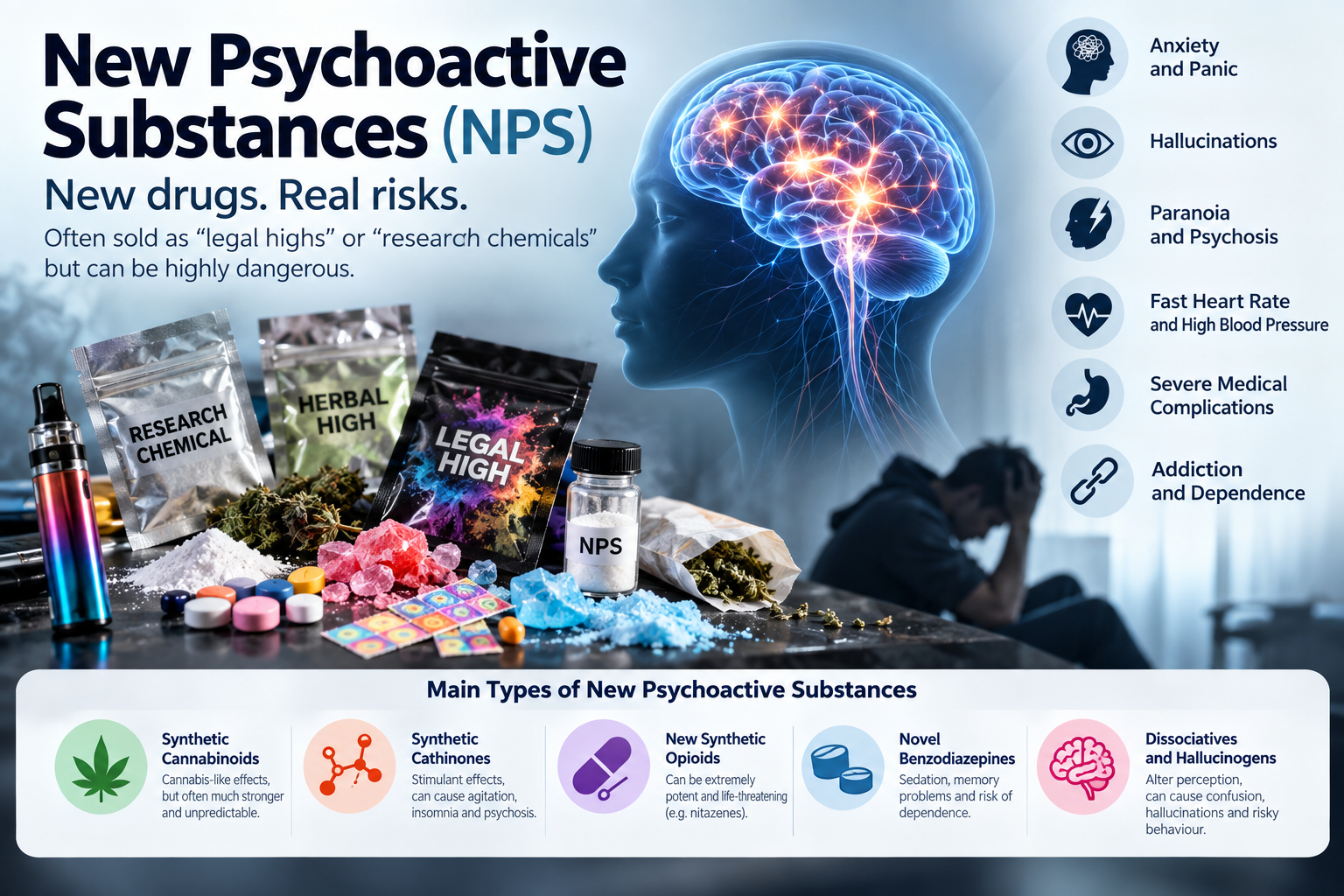
New psychoactive substances (NPS) are becoming an increasingly important challenge in addiction medicine and public health. They include a rapidly changing group of synthetic or semi-synthetic substances that can produce stimulant, opioid, sedative, hallucinogenic, dissociative or cannabis-like effects.
The term “new” does not necessarily mean that the substance itself was recently invented. Rather, NPS are substances that have emerged on drug markets and may not have been controlled under international drug conventions when they first appeared.
Sometimes they are marketed under misleading names such as “legal highs,” “research chemicals,” “herbal highs,” or “bath salts.” These labels can create a false impression that the products are safe. They are not.
⸻
Why are new psychoactive substances becoming a concern?
The traditional drug market was relatively easier to monitor because clinicians and laboratories knew what substances they were looking for.
NPS have changed that situation.
Manufacturers can chemically modify an existing psychoactive compound and introduce a new substance with similar or sometimes much more potent effects. By the time health professionals and laboratories understand one substance, another may already have appeared.
The scale of this phenomenon is substantial. As of August 2026, the UNODC Early Warning Advisory had received reports of 1,525 individual NPS from 155 countries and territories.
Importantly, this does not mean that 1,525 substances are all commonly used or equally dangerous. It demonstrates how rapidly and diversely the drug market can evolve.
⸻
What are the main types of NPS?
NPS are chemically diverse. Some major groups include:
1. Synthetic cannabinoids
These substances are designed to produce effects resembling cannabis but can behave very differently from natural cannabis.
They may cause:
* Severe anxiety or agitation * Panic * Confusion * Hallucinations * Paranoia * Psychosis * Seizures * Cardiovascular complications
Some products can produce much stronger and less predictable effects than users expect.
⸻
2. Synthetic cathinones
Often referred to as “bath salts” in popular culture, synthetic cathinones are stimulant-type substances.
They can cause:
* Increased energy and alertness * Agitation * Insomnia * Anxiety * Paranoia * Aggression * Hyperthermia * Tachycardia * Psychosis
Examples of substances in this broad group include various substituted cathinones such as 3-MMC and related compounds.
⸻
3. New synthetic opioids
This is one of the most concerning developments in the NPS market.
Nitazenes, for example, are a group of highly potent synthetic opioids. Some can be extremely powerful, creating a substantial risk of respiratory depression and fatal overdose.
The European Union Drugs Agency reported that seven new opioids were notified in Europe in 2025, including highly potent nitazenes and other novel opioids. Since 2009, 95 new opioids had been identified on the European drug market.
This is particularly concerning when such substances are present in counterfeit tablets or mixed unknowingly with other drugs.
⸻
4. Novel benzodiazepines
Some NPS are chemically related to benzodiazepines and may produce:
* Sedation * Drowsiness * Memory impairment * Poor coordination * Respiratory depression, particularly when combined with opioids or alcohol * Dependence and withdrawal
Because the exact compound and dose may be unknown, the clinical response can be difficult to predict.
⸻
5. Dissociative and hallucinogenic NPS
These substances may alter perception, cognition and the sense of reality.
Potential effects include:
* Dissociation * Hallucinations * Confusion * Panic * Impaired judgment * Psychotic symptoms * Accidents and injuries
⸻
How common is NPS use?
Obtaining a single global prevalence figure is difficult.
One reason is that NPS markets change rapidly, while conventional population surveys may not include newly emerging substances. People may also be unaware of the exact substance they have consumed.
The European data illustrate this problem.
The 2024 ESPAD school survey estimated that average lifetime NPS use among European 15–16-year-old students was 2.6%, although individual countries ranged from 0.6% to 6.4%.
Among young adults aged 15–34, national estimates of past-year NPS use ranged from 0.1% to 2.9% in the latest EUDA data, depending on country and methodology.
Another source provides a very different picture: in the 2024 European Web Survey on Drugs, which was a non-representative survey of people who already use drugs, 16% of respondents reported NPS use during the previous 12 months.
These figures should not be directly compared as if they measured the same population. They demonstrate why NPS surveillance requires careful interpretation.
⸻
What is happening globally?
UNODC surveillance shows that NPS are not restricted to Europe or North America.
By October 2025, 153 countries and territories had reported one or more NPS to the UNODC Early Warning Advisory.
In 2024 alone, 101 NPS were reported to UNODC for the first time by 45 countries, within a total of 688 unique NPS reported that year. Synthetic cannabinoid receptor agonists were the largest group among newly reported substances, accounting for 29% of the newly reported NPS.
This changing landscape is one reason addiction specialists, emergency physicians, psychiatrists, toxicologists and forensic laboratories need effective early-warning systems.
⸻
Why are NPS particularly dangerous?
The biggest problem is uncertainty.
With an NPS, a person may not know:
* What chemical they have taken * How concentrated it is * Whether it contains another drug * Whether the product has been contaminated * How long its effects will last * How it will interact with prescribed medication * Whether the substance is capable of causing dependence
Two products sold under the same informal name may not contain the same chemical.
This creates a dangerous gap between what the person thinks they are taking and what their body actually receives.
⸻
Mental health effects of NPS
NPS are particularly relevant to psychiatry.
Some users experience acute psychiatric symptoms such as:
Anxiety → panic → paranoia → agitation → hallucinations → psychosis
In vulnerable individuals, substance-induced psychiatric symptoms may become severe enough to require emergency assessment or hospitalization.
Repeated exposure can also be associated with problematic substance use and dependence.
Clinicians should therefore consider NPS exposure when a patient presents with new-onset psychosis, severe agitation, unusual intoxication, unexplained delirium, seizures or rapidly changing mental status, particularly when the clinical picture does not fit the patient’s reported substance use.
⸻
Can NPS cause addiction?
Yes.
Not every person who experiments with an NPS will develop a substance use disorder, but some NPS can produce powerful reinforcement, tolerance, craving and withdrawal.
Risk may be increased by:
* Repeated use * High-potency substances * Polysubstance use * Previous addiction * Mental health disorders * Trauma * Social stress * Easy availability * Using substances to cope with emotional distress
WHO notes that psychoactive drug use without medical supervision can lead to drug use disorders and can cause substantial impairment in personal, family, educational and occupational functioning.
⸻
Why routine drug tests may miss NPS
This is an important issue for families and clinicians.
A conventional urine drug screen usually looks for selected drug classes or specific metabolites. It does not automatically detect every newly emerging psychoactive substance.
Therefore:
A negative routine drug screen does not necessarily mean that a person has not used an NPS.
When the clinical history and presentation suggest exposure, specialist toxicology testing may sometimes be required.
This is one reason collaboration between addiction psychiatrists, emergency physicians, toxicologists and specialized laboratories is increasingly important.
⸻
What does NPS treatment involve?
There is no single medication that treats every NPS.
Treatment depends on:
* The substance involved * The pattern and severity of use * Withdrawal symptoms * Medical complications * Psychiatric symptoms * Co-occurring substance use * The presence of a substance use disorder
Acute intoxication
Severe intoxication may require emergency medical assessment, monitoring and supportive treatment.
Patients with significant:
* altered consciousness * respiratory depression * seizures * severe agitation * hyperthermia * chest pain * severe psychosis
may require urgent hospital care.
Longer-term treatment
For patients who develop a substance use disorder, treatment may include:
* Comprehensive psychiatric assessment * Addiction assessment * Medical evaluation * Withdrawal management when indicated * Psychotherapy * Motivational interviewing * Cognitive behavioural approaches * Family interventions * Relapse-prevention planning * Treatment of depression, anxiety, psychosis or other co-occurring disorders * Structured inpatient rehabilitation when clinically appropriate * Outpatient follow-up and recovery support
The important principle is to treat the person, not simply the name of the drug.
⸻
NPS and dual diagnosis
A particularly important clinical issue is dual diagnosis — the coexistence of a substance use disorder with a psychiatric disorder.
Someone using NPS may also have:
* Depression * Anxiety * ADHD * Bipolar disorder * PTSD * Personality disorders * Psychotic disorders * Sleep disorders
Sometimes the psychiatric symptoms predate substance use. In other cases, drug exposure can trigger or worsen them.
A proper assessment therefore needs to look beyond intoxication and ask:
Why is the person using the substance?
What happens when they stop?
Are psychiatric symptoms present during periods of abstinence?
Is the substance being used to self-medicate emotional distress?
These questions can significantly change the treatment plan.
⸻
NPS in Pakistan: what do we know?
This is an area where caution is important.
Pakistan has established national drug surveillance and prevention systems, but recent nationally representative prevalence data specifically for NPS remain limited compared with some European surveillance systems.
Pakistan’s last National Drug Survey was conducted in 2013, and in July 2024 the government announced plans for a new national drug survey to update national estimates.
A 2025 study from Aga Khan University provides useful information about broader drug-use patterns in Pakistan. Researchers reviewed 130,859 drug-screening tests collected between 2008 and 2022. About 4.8% were positive for at least one of the substances included in that laboratory panel, with cannabis, opioids, benzodiazepines and alcohol among the most frequently detected categories. Importantly, this was a laboratory-based observational dataset rather than a nationally representative population survey, and its testing panel did not capture the full range of NPS.
Therefore, it would be inappropriate to claim a precise national prevalence of NPS use in Pakistan based on currently available evidence.
What we can say is that the global emergence of NPS makes improved surveillance and laboratory capacity increasingly important for Pakistan as well.
⸻
What should parents and families watch for?
A sudden change in behaviour does not automatically mean NPS use. However, warning signs can include:
* Unexplained episodes of extreme agitation * Sudden paranoia or hallucinations * Severe insomnia * Marked changes in mood * Unusual intoxication * Recurrent unexplained medical emergencies * Sudden decline in academic or occupational functioning * Secretive behaviour around unknown pills, powders or vaping products * Multiple substances being used together
The appropriate response is not confrontation or punishment.
A calm conversation followed by professional assessment is generally more helpful.
⸻
When should someone seek professional help?
Professional help is particularly important when substance use is accompanied by:
* Repeated failed attempts to stop * Strong cravings * Withdrawal symptoms * Increasing tolerance * Loss of control over use * Neglect of work, education or family responsibilities * Recurrent intoxication * Psychosis or severe paranoia * Depression or suicidal thoughts * Overdose * Mixing multiple substances
Emergency symptoms such as unconsciousness, slow or difficult breathing, seizures, severe confusion, extreme agitation, high body temperature or suspected overdose require urgent medical attention.
⸻
The future of NPS surveillance
The NPS problem is unlikely to disappear simply through the prohibition of individual compounds.
The history of NPS demonstrates a recurring cycle:
New compound → detection → health concerns → regulation → replacement compound → new health concerns
That means modern addiction medicine needs more than legislation.
It requires:
* Early-warning systems * Laboratory surveillance * Toxicology capacity * Research * Public education * Evidence-based prevention * Accessible addiction treatment * Mental-health services * International information sharing
WHO continues to review emerging substances for their potential health risks and international control. In 2025, its Expert Committee on Drug Dependence reviewed several novel synthetic opioids, a synthetic cannabinoid, a dissociative substance and a cathinone/stimulant.
In April 2026, the UN Commission on Narcotic Drugs acted on WHO recommendations to place three harmful NPS—including a potent synthetic opioid and a synthetic cannabinoid—under international control.
⸻
Final message
New psychoactive substances represent one of the fastest-changing areas of modern addiction medicine.
Their greatest danger is not simply that they are “new.” It is that their composition, potency, effects and risks may be poorly understood at the time people begin using them.
For patients and families, the most important message is simple:
Do not assume that a product is safe because it is sold as a “legal high,” “herbal product,” “research chemical,” vape product or something described as a safer alternative to another drug.
If substance use is becoming difficult to control, or if it is accompanied by psychiatric or physical problems, professional assessment can make a significant difference.
At RehabConnect, our goal is to make evidence-based information about addiction, psychiatry, treatment and recovery easier for patients and families to understand and access.
⸻
Frequently Asked Questions
What are new psychoactive substances?
New psychoactive substances are a diverse group of synthetic or semi-synthetic substances that produce psychoactive effects and have emerged on drug markets, often outside the traditional range of controlled drugs.
Are NPS the same as “legal highs”?
No. “Legal high” is a misleading informal term. A substance’s legal status does not determine whether it is safe.
Can NPS cause psychosis?
Yes. Some NPS can produce severe paranoia, hallucinations, agitation and psychotic symptoms.
Can NPS cause addiction?
Yes. Some NPS can produce tolerance, craving, withdrawal and other features of substance use disorder.
Will a normal drug test detect NPS?
Not necessarily. Routine screening panels do not detect every emerging psychoactive substance.
Is there treatment for NPS addiction?
Yes. Treatment is individualized and may include medical assessment, withdrawal management, psychotherapy, addiction treatment, psychiatric care, family intervention, rehabilitation and relapse prevention.
Are NPS a problem in Pakistan?
NPS are a global phenomenon, and Pakistan has established drug surveillance and prevention systems. However, current nationally representative data specifically measuring NPS prevalence in Pakistan are limited. More comprehensive surveillance is needed.
⸻
References & Further Reading
1. United Nations Office on Drugs and Crime (UNODC). Early Warning Advisory on New Psychoactive Substances. 2. UNODC, 2025. 101 newly emerged NPS reported in 2024, with semi-synthetic cannabinoids and synthetic opioids taking the lead. 3. UNODC, 2026. Global Forensic Early Warning System monitors over 1,500 psychoactive substances. 4. European Union Drugs Agency (EUDA), 2026. European Drug Report 2026: New psychoactive substances. 5. WHO Expert Committee on Drug Dependence, 2025. Forty-seventh report. 6. Peacock A, et al. New psychoactive substances: challenges for drug surveillance, control, and public health responses. The Lancet, 2019;394:1668–1684. 7. Sarfaraz Y, et al. Exploring landscape of drug abuse trends in Pakistan: A decade and a half of clinical laboratory big data analysis. PLOS Global Public Health, 2025;5:e0004424. 8. Government of Pakistan, 2024. Announcement regarding the proposed National Drug Survey.
Medically Reviewed by Dr. Muhammad Shoaib Zafar, Consultant Psychiatrist & Addiction Specialist